

One of the most practical and underappreciated advantages of GIFT City for NRI investors is the trading hours available on its international exchanges. If you have ever tried to track Indian markets from the US or stay awake to place trades from the UK, you know exactly how inconvenient the 9:15 AM to 3:30 PM IST mainland trading window can be. GIFT City changes that significantly.
The Mainland Problem
The National Stock Exchange and the Bombay Stock Exchange operate from 9:15 AM to 3:30 PM IST, Monday to Friday. For an NRI in New York, that translates to approximately 11:45 PM to 6:00 AM Eastern Time. For someone in London, it means trading from 3:45 AM to 10:00 AM. For those in Singapore or Dubai, the hours are slightly better but still not aligned with a typical working day.
This creates a genuine problem. Active traders either have to stay up late, wake up very early, or simply miss the market entirely and rely on limit orders placed the night before.
The GIFT City Solution: 21-Hour Trading
The GIFT Nifty contract, which trades on NSE IFSC at GIFT City, is available for 21 hours a day. The trading session runs from 6:30 AM IST to 2:45 AM IST the following day. Here is how those hours translate for NRIs across the world:
- United States (EST): GIFT Nifty is available from approximately 8:00 PM to 5:10 PM the following day, effectively covering most waking hours
- United Kingdom (GMT): Available from approximately 1:00 AM to 10:10 PM, covering the entire working day
- UAE (GST): Available from approximately 5:00 AM to 2:10 AM, covering both the working day and evening hours
- Singapore (SGT): Available from approximately 9:00 AM to 6:10 AM, covering well into the next day
Why Does the 21-Hour Window Exist?
The extended trading hours on GIFT Nifty are designed to align with global market activity. Global participants who want exposure to Indian market movements need to be able to trade at hours that coincide with their own working schedules. Before GIFT Nifty, the Nifty contract was available on the Singapore Exchange (SGX), which allowed international participants to trade a proxy for the Indian market during Asian and European hours.
GIFT City effectively brought that function back to Indian soil. When the SGX Nifty was discontinued and replaced by GIFT Nifty on NSE IFSC, it marked a significant step in bringing offshore Indian market activity within India’s regulatory framework while maintaining the global accessibility that international investors required.
What Can You Trade During These Hours?
The extended session at GIFT City primarily covers index derivatives and equity derivatives on NSE IFSC and India INX. The GIFT Nifty contract is the flagship product, but the exchanges also offer:
- Single-stock futures and options on major Indian companies
- Currency derivatives
- Commodity derivatives
- US equity derivatives and international index products
GIFT Nifty vs NSE Nifty: A Key Distinction
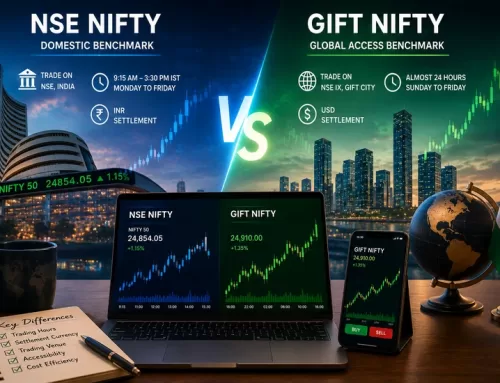
GIFT Nifty is the Nifty 50 futures contract traded on NSE IFSC at GIFT City. It tracks the same underlying index as the NSE Nifty 50, but it trades in US dollars and for 21 hours a day. It functions as the global benchmark for Indian market sentiment during hours when the mainland NSE is closed. Institutional investors and foreign portfolio investors often use GIFT Nifty to hedge or express views on the Indian market outside mainland trading hours.
Practical Implications for NRI Investors
Beyond active trading, the 21-hour window has broader significance. When major global events happen overnight in the Indian IST time zone, such as a US Federal Reserve announcement or a geopolitical development, the mainland Indian market only reacts at 9:15 AM the next day. But GIFT Nifty reacts in real time. This means NRI investors with GIFT City accounts can respond to these events as they happen, rather than waiting for the mainland to open.
Bottom Line
The 21-hour trading window at GIFT City is not just a convenience feature. For NRIs who want to stay actively engaged with Indian markets from wherever they are in the world, it is a fundamental shift in how accessible Indian market participation can be. No more alarm clocks set for 3 AM.







Leave A Comment