
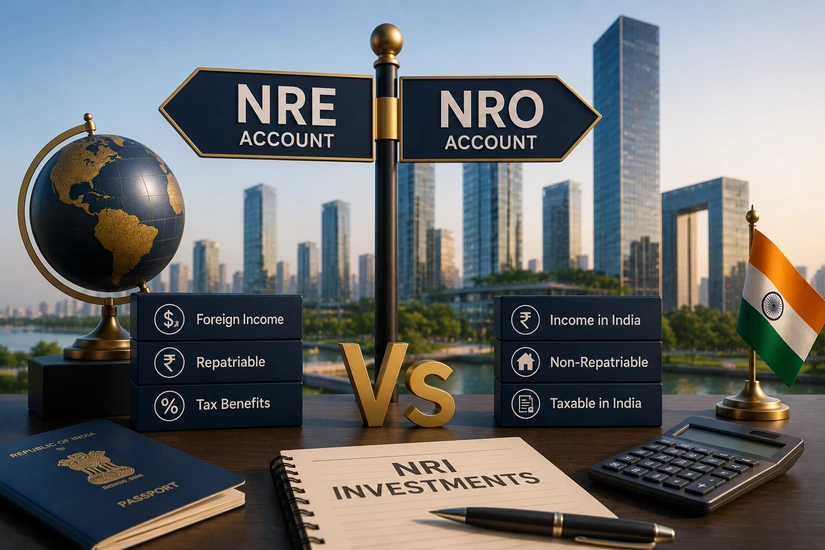
If you are a Non-Resident Indian who wants to manage or invest money in India, one of the first things you will encounter is the question of which bank account to use. The two most common options are the NRE (Non-Resident External) account and the NRO (Non-Resident Ordinary) account. Many NRIs find the distinction confusing and getting it wrong can create complications when it comes to taxation, repatriation, and investment eligibility.
This blog explains the key differences in plain terms and introduces why GIFT City offers a cleaner and simpler route for many types of NRI investments.
What Is an NRE Account?
An NRE account is a Rupee-denominated bank account in India that is funded using money earned outside India. The key features are:
- The account is in Indian Rupees (INR), but the money deposited comes from your foreign earnings converted at the current exchange rate.
- Interest earned on NRE accounts is fully exempt from tax in India.
- Funds in the NRE account are freely repatriable, meaning you can transfer the money back abroad without restrictions.
- Both the principal and interest can be sent back to your country of residence without limit.
What Is an NRO Account?
An NRO account is used to manage income earned within India. This includes rental income from property, pension, dividends from Indian investments, and any other income that originates in India. The key features are:
- The account is also in Indian Rupees (INR).
- Interest earned on NRO accounts is taxable in India at 30% plus applicable surcharge and cess.
- Repatriation from NRO accounts is subject to a limit of USD 1 million per financial year and requires specific documentation and clearances.
- You can also deposit foreign earnings into an NRO account, but the repatriation limitations still apply.
Which One Should You Use?
The simple way to think about it is this: use an NRE account for foreign earnings that you want to keep flexible and tax-free in India and use an NRO account for managing income generated within India. Many NRIs have both accounts and use them for different purposes.
Where Does GIFT City Come In?
When you invest through GIFT City’s IFSC, the framework is different from both NRE and NRO accounts. At GIFT City, transactions are conducted in foreign currency, primarily US dollars, rather than in Indian Rupees. This means the NRE or NRO account framework does not directly apply to GIFT City investment accounts. Instead, you open a foreign currency account with an IFSCA-regulated broker or bank at GIFT City and invest directly from there.
For NRIs, this has some meaningful advantages:
- You avoid the currency conversion cost that comes with NRE accounts, where you convert foreign currency to INR and then back when you want to exit
- Repatriation from GIFT City is generally simpler because the account is already in foreign currency
- Investments in global equities, international ETFs, and other USD-denominated instruments are handled cleanly through a single GIFT City account
- The compliance burden is reduced because IFSCA is the single regulator, rather than navigating the combined requirements of RBI, SEBI, and your bank
A Practical Note
If you are an NRI who has both Indian-sourced income and foreign earnings, maintaining an NRE and NRO account alongside a GIFT City investment account is a sensible structure. The GIFT City account handles your global and IFSC market investments, the NRE account holds foreign savings in India, and the NRO account receives Indian income. Each serves a distinct purpose.






Leave A Comment