If you are an NRI or a global investor with exposure to Indian markets, you have probably come across two terms that sound almost identical: NSE Nifty and GIFT Nifty. Many people assume they are the same thing. They track the same underlying index, after all. But the differences between them are significant, and understanding these differences can directly affect your trading decisions, your costs, and your overall experience.
What Is NSE Nifty?
The NSE Nifty, formally known as the Nifty 50, is India’s most widely followed stock market index. It represents the top 50 companies based on market capitalization listed on the National Stock Exchange of India, covering a broad cross-section of sectors including banking, IT, energy, consumer goods, pharma etc. The Nifty 50 is the benchmark for Indian equity markets and is used as a reference by domestic and international investors to gauge the health of the Indian economy.
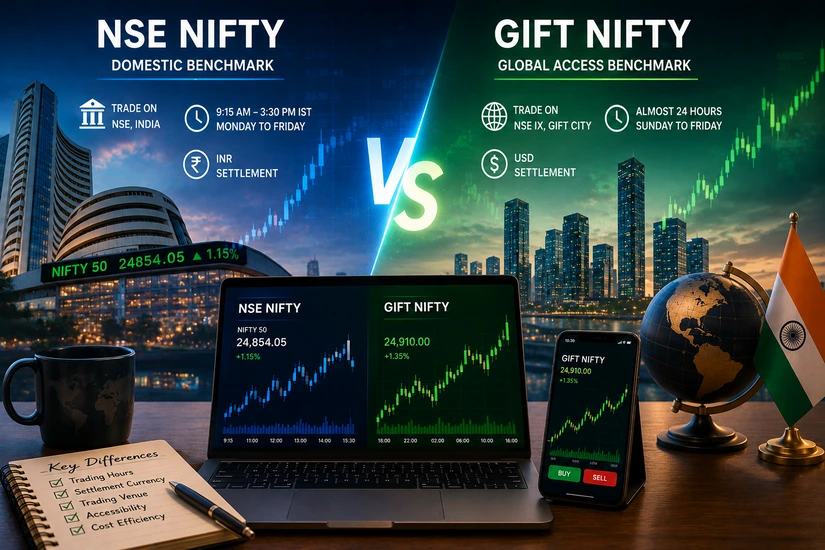
Nifty futures and options are traded on the National Stock Exchange (NSE) in Mumbai. These contracts are priced in Indian Rupees and are available to trade from 9:15 AM to 3:30 PM IST on weekdays.
What Is GIFT Nifty?
GIFT Nifty is the Nifty 50 futures contract that trades on NSE IFSC, which is the international exchange located within GIFT City in Gandhinagar, Gujarat. Structurally, it tracks the same Nifty 50 index. However, there are important differences in how it operates.
GIFT Nifty was launched after the SGX Nifty, which previously traded on the Singapore Exchange, was transitioned to NSE IFSC in 2023. This move brought the offshore Indian market benchmark instrument within India’s own regulatory territory for the first time.
Key Differences Between GIFT Nifty and NSE Nifty
Trading Hours: NSE Nifty trades from 9:15 AM to 3:30 PM IST. GIFT Nifty trades for 21 hours a day, from 6:30 AM to 2:35 AM IST the following day. This extended session is specifically designed to serve global market participants who cannot access the mainland during regular Indian market hours.
Currency of Settlement: NSE Nifty futures settle in Indian Rupees. GIFT Nifty futures settle in US dollars. This is a crucial distinction for NRIs and global investors who operate in foreign currency, as it eliminates currency conversion friction and costs.
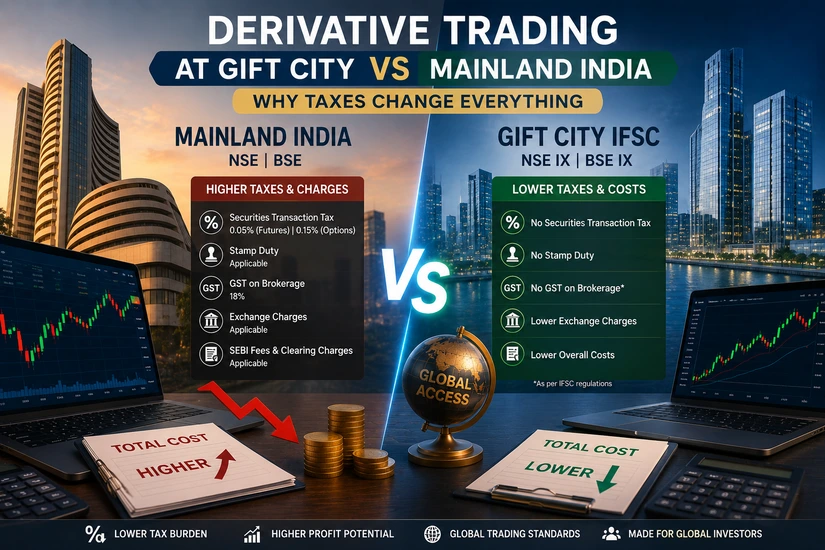
Transaction Tax: NSE Nifty transactions on the mainland are subject to Securities Transaction Tax (STT). GIFT Nifty transactions on NSE IFSC are not subject to STT. This is a direct cost saving for high-frequency traders and institutional participants who trade large volumes.
Stamp Duty: Stamp duty applies to transactions on mainland NSE. It does not apply to GIFT Nifty transactions at GIFT City. Another layer of cost saving.
Regulatory Oversight: NSE Nifty is regulated by SEBI. GIFT Nifty is regulated by IFSCA. While both are Indian regulators, IFSCA is specifically designed for international financial services and operates a framework more aligned with global standards.
Participant Base: NSE Nifty is predominantly traded by domestic retail investors, domestic institutions, and domestic brokers. GIFT Nifty has a higher proportion of international participants, including Foreign Portfolio Investors (FPIs), global hedge funds, and NRIs, given its accessibility during international market hours.
Why Does GIFT Nifty Matter for NRIs?
For an NRI trader, GIFT Nifty is often the more practical choice for taking positions on the Nifty 50. The reasons are straightforward. First, you can trade during your own waking hours, whether you are in Dubai, London, or Toronto. Second, your account and settlements are in foreign currency, which matches your income and spending currency. Third, the absence of STT makes trading more cost-efficient, particularly if you are an active trader.
There is also an informational advantage. Since GIFT Nifty trades during hours when the Indian mainland is closed, it reflects how global markets are pricing Indian equity risk in real time. If there is a major event overnight, GIFT Nifty will move before the mainland NSE opens. Monitoring GIFT Nifty gives you a live reading of market sentiment on India beyond mainland trading hours.
Which One Should You Use?
If you are an Indian resident trading from India during regular hours, and your account is in Rupees, the mainstream NSE Nifty contracts make sense. However, if you are an NRI, operating in foreign currency, wanting to trade outside regular Indian hours, or looking to reduce transaction costs, GIFT Nifty via a GIFT City account is the more appropriate instrument.
It is also worth noting that for pure hedging purposes, the two contracts are highly correlated since they track the same underlying index. The choice comes down primarily to operating currency, hours, and cost structure.
A Quick Summary
Same underlying index, different market. NSE Nifty is in Rupees, on the mainland, 6.25 hours a day. GIFT Nifty is in US dollars, at GIFT City, 21 hours a day, with no STT and no stamp duty. For NRIs and global investors, GIFT Nifty is generally the better-suited instrument.





Leave A Comment