Derivative trading, whether in futures or options on indices or individual stocks, is one of the most active segments of Indian financial markets. India has one of the highest volumes of options trading in the world. But when it comes to where you choose to trade derivatives, the tax and cost structure at GIFT City’s International Financial Services Centre is meaningfully different from the mainland. For active traders and institutional participants, this difference can translate into significant savings over time.
The Mainland Derivatives Landscape
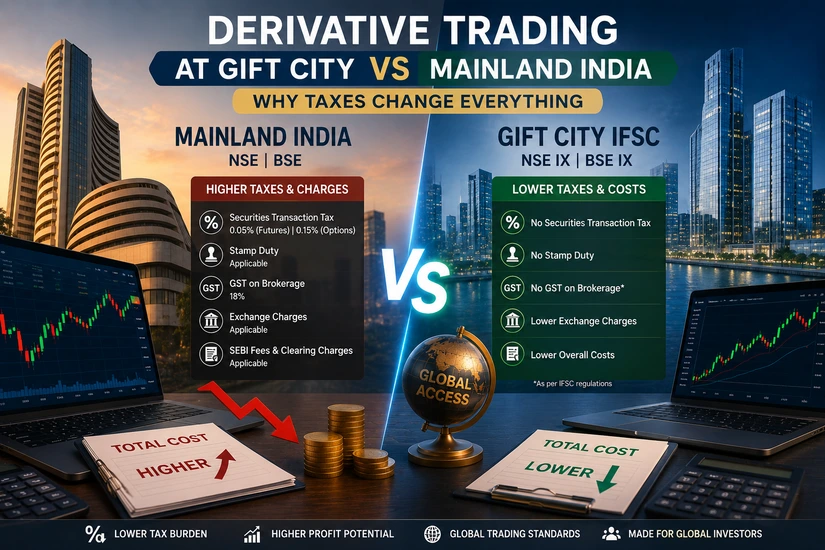
On the mainland NSE and BSE, derivative trading is subject to a range of taxes and charges. Securities Transaction Tax applies to all derivative transactions. The rate for futures is 0.05% of the contract value, and for options, it is 0.15% of the premium. Stamp duty also applies at the state level. Add to this the Goods and Services Tax (GST) on brokerage, exchange transaction charges, SEBI regulatory fees, and clearing charges, and the total cost of a derivative transaction on the mainland adds up across all these components.
For a trader doing high volume, these costs accumulate meaningfully. A trader executing hundreds of lots per month can end up paying lakhs of rupees in STT alone in a single financial year.
The GIFT City Derivatives Landscape
At GIFT City’s IFSC exchanges, specifically NSE IFSC and India INX, the cost structure is fundamentally different:
- Securities Transaction Tax does not apply to transactions at GIFT City
- Stamp duty does not apply to GIFT City transactions
- Transactions are in US dollars, which benefits NRIs and foreign currency investors
- The single-regulator model under IFSCA simplifies compliance costs
While exchange transaction charges and brokerage still apply, the removal of STT and stamp duty alone makes GIFT City significantly more cost-efficient for high-volume derivative traders.
The Tax Treatment of Derivative Gains
Mainland India: On the mainland, profits from futures and options are classified as business income for tax purposes for Indian residents and NRIs, regardless of how the individual characterizes their trading activity. This means they are taxed at the individual’s applicable income tax slab rate. But for FPIs the income will be flat 20%. These taxes are charged over and above securities transaction tax. Additionally, the deduction for expenses incurred in trading activity, such as brokerage or internet costs (STT cannot be included), is available, but the overall tax rate remains high.
GIFT City: No tax charged is on the income earned on derivatives by the NRIs and other foreign investors in the GIFT City.
The Practical Impact for an NRI Derivatives Trader
Consider an NRI based in the UAE, with no personal income tax. If this NRI trades GIFT Nifty derivatives at GIFT City:
- No STT on his transactions
- No stamp duty on his transactions
- No capital gain on the derivative income
- Trading available in US dollars during UAE working hours
- Single regulatory framework under IFSCA
Compare this to the same NRI trading NSE Nifty on the mainland, where STT, stamp duty, and the full domestic tax framework apply. The difference in overall cost and tax burden is substantial, especially if the NRI is an active trader.
What About Indian Resident Traders?
For Indian resident traders, the GIFT City advantage is different. Individual Indian resident is not allowed to trade via GIFT city in international and Indian derivatives, but he can trade Gift Nifty and Sensex India INX through proprietary trading.
Choosing the Right Market for Your Derivatives Activity
The right choice depends on your profile. If you are an Indian resident focused on domestic derivatives, the mainland likely remains your primary market. If you are an NRI focused on Indian market exposure through GIFT Nifty or international derivatives, GIFT City offers a materially better cost and tax structure. And if you are an HNI trading large volumes, the savings from STT alone at GIFT City can justify the shift.
The Bottom Line on Taxes
For NRIs, the combination of no STT, no stamp duty, USD settlement, and 21-hour trading access, and makes derivative trading at GIFT City substantially more cost-efficient than the mainland. The exact benefit depends on your residency, treaty position, and trading volume. Speaking with a GIFT City broker and a tax advisor together is the best way to quantify what it means for you specifically.








Leave A Comment