
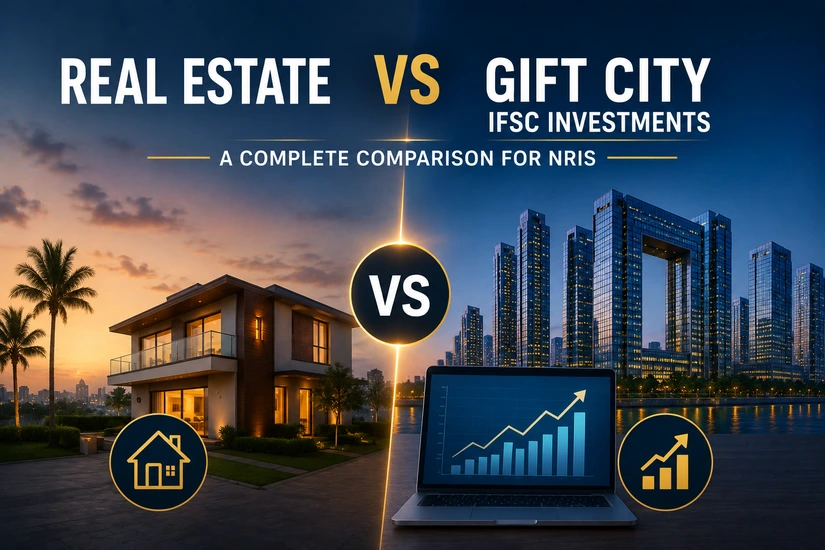
For generations, real estate has been the default investment choice for NRIs investing in India. Whether it is a flat in Mumbai, a villa in Goa, a plot in the hometown, or a commercial property in Bengaluru, property investment has been seen as the most tangible and trustworthy way to maintain a financial footprint in India. It is familiar, and it feels solid.
GIFT City IFSC investments represent a fundamentally different approach to India-linked investing. They are financial market instruments, held in a regulated account, in foreign currency, accessible from anywhere in the world. The comparison between the two is increasingly relevant, and the outcome depends heavily on what you are actually trying to achieve.
What You Are Actually Comparing
Real estate investment in India for NRIs typically means: buying a residential or commercial property, holding it for capital appreciation over several years, possibly earning rental income, and eventually selling it or passing it on. The entire lifecycle can span ten to twenty years or more.
GIFT City IFSC investments for NRIs can mean: trading derivatives on Indian indices, investing in US equities, putting money into an IFSCA-regulated AIF, or building a portfolio of international ETFs, all from a foreign currency account governed by IFSCA. Liquidity and holding periods vary significantly across these instruments.
Liquidity: A Fundamental Difference
Real estate is illiquid by nature. Selling a property in India involves finding a buyer, negotiating a price, paying capital gains tax (and potentially TDS), handling stamp duty and registration, and managing the transaction logistics. This process can take months, and in a weak market, it can take years. There is no guaranteed exit at any given price or time.
GIFT City financial investments vary widely in liquidity. Listed instruments like GIFT Nifty derivatives, US equities, and ETFs are highly liquid and can be exited on the same day. IFSCA-regulated AIFs are illiquid for their investment period (typically three to seven years for private equity funds), but even the most illiquid GIFT City investment is typically faster to exit than real estate.
Capital Requirements
Buying a meaningful property in a major Indian city typically requires several tens of lakhs to crores of rupees, and this is before accounting for registration, stamp duty, interior work, and maintenance. It is inherently a large-ticket, lumpy investment.
GIFT City investments can be accessed at much lower entry points. You can start a portfolio of US equities through fractional trading with a few hundred dollars. IFSCA-regulated mutual funds may have relatively modest minimums. AIFs have higher minimums (typically equivalent to Rs 1 crore or above), but are still accessible to a broader range of HNI NRIs than, say, a prime commercial property in Mumbai.
Returns and Income
Real Estate: Capital appreciation on Indian property has been meaningful in prime locations over long horizons. Rental yields in India are typically low (2 to 3% net of costs), meaning real estate is primarily a capital appreciation play rather than an income play. Returns are Rupee-denominated, so an NRI receives Rupees from rental income or sale proceeds, which then need to be repatriated or converted.
GIFT City IFSC: Returns depend entirely on what you invest in. Equity markets have historically delivered strong long-term returns, though with higher volatility. AIFs in private equity or venture capital can deliver higher returns than public markets over long periods, with commensurately higher risk. Importantly, all returns from GIFT City accounts are in foreign currency, which has historically benefited Indian investors due to INR depreciation against the dollar over the long term.
Tax Treatment
Real Estate: NRIs selling Indian property are subject to capital gains tax in India: 20% with indexation for long-term gains on property held for more than two years, and income tax slab rates for short-term gains. There is also TDS (Tax Deducted at Source) at the time of sale, which the buyer deducts. Rental income is taxable in India, and repatriation requires compliance with RBI rules.
GIFT City IFSC: Tax treatment at GIFT City depends on the investment type and the NRI’s country of residence. DTAA benefits may apply, potentially reducing the effective tax rate on capital gains. No STT, no stamp duty on GIFT City transactions. Section 80LA benefits apply to the broker, reducing their operating costs. Overall, the GIFT City tax structure is generally more efficient than real estate for NRIs.
Regulatory and Management Complexity
Managing a property in India from abroad is notoriously complex. You need a trusted person on the ground for maintenance, tenant management, and legal compliance. Property disputes are common and can take years to resolve through Indian courts. FEMA regulations govern repatriation of sale proceeds, and there are specific rules about how many properties an NRI can hold and repatriate proceeds from.
GIFT City investments are managed through a regulated broker’s online platform. You can monitor, buy, sell, and repatriate from anywhere in the world. IFSCA oversight provides investor protection. There are no physical assets to manage, no maintenance issues, and no on-ground representatives needed.
The Emotional Factor
It would be incomplete to discuss this topic without acknowledging the emotional dimension. For many NRIs, owning property in India is not purely a financial decision. It is a connection to their roots, a physical presence in their hometown, a tangible asset they can show and visit. This emotional value is real and should be acknowledged. Financial returns alone do not capture why many NRIs hold Indian property.
GIFT City investments do not offer this emotional dimension. They are financial instruments, not physical assets with emotional meaning. For NRIs who want to maintain a tangible Indian connection, property serves that purpose in a way that a trading account cannot.
Putting It Together: Which Is Right for You?
- If you want long-term capital appreciation, combined with the emotional value of owning Indian real estate and you have a trusted management arrangement in India, real estate continues to make sense as part of a diversified NRI portfolio
- If you want liquidity, foreign currency returns, global diversification, and a hands-off regulated investment structure, GIFT City IFSC investments are clearly superior
- If you are choosing between the two purely on financial grounds, the case for GIFT City is strong: better liquidity, foreign currency denomination, no STT, simpler tax treatment, and no on-ground management burden
- For most sophisticated NRI investors, a combination of both makes sense: a property holding for emotional and Rupee-denominated capital appreciation, alongside a GIFT City portfolio for foreign currency exposure, global diversification, and liquidity
The Core Difference in One Line
Real estate is illiquid, Rupee-denominated, emotion-laden, and complex to manage from abroad. GIFT City IFSC investments are liquid, foreign-currency-denominated, professionally regulated, and accessible from anywhere in the world. Both have a place in a sophisticated NRI portfolio, and they serve different purposes.
Bonanza IFSC helps NRIs build regulated, professionally managed investment portfolios at GIFT City. If you are evaluating how GIFT City investments fit alongside your existing India holdings, including real estate, reach out to us for a detailed discussion.


Leave A Comment