
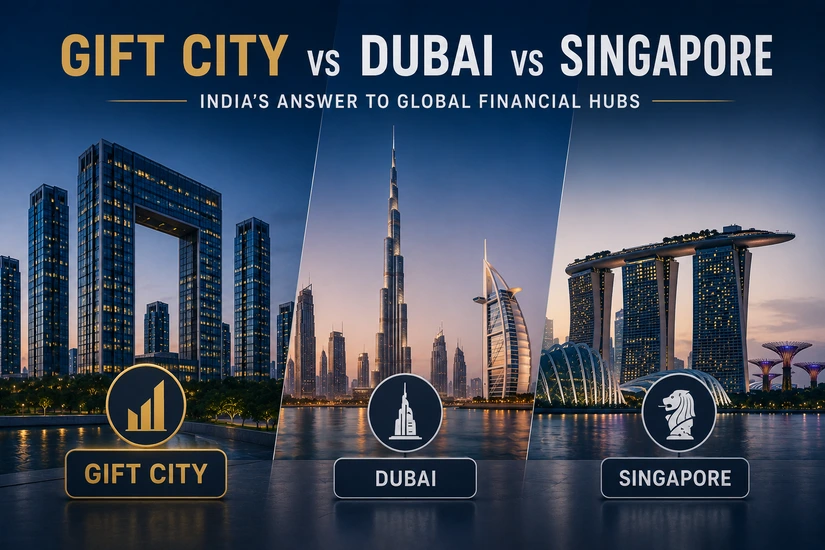
For decades, NRIs and global investors with India connections have used Singapore and Dubai as their financial base for India-related and international investments. Both cities built world-class financial infrastructure, offered tax efficiency, and provided access to Indian and global markets from neutral, internationally credible locations. They were, for a long time, the obvious choice.
GIFT City was built with the explicit ambition of offering an alternative. The question worth asking honestly is: how does it compare today, and for which investors does GIFT City actually win?
Singapore: Asia’s Preeminent Financial Hub
Singapore’s financial hub status is built over decades of deliberate policy, world-class infrastructure, and a consistent commitment to regulatory quality. The Monetary Authority of Singapore (MAS) is widely regarded as one of the most credible regulators in the world. Singapore offers:
- A comprehensive network of over 80 tax treaties, making it highly efficient for cross-border tax planning
- Zero capital gains tax (Singapore does not tax capital gains at all)
- A deep financial ecosystem with hundreds of global banks, fund managers, family offices, and asset managers
- Strong legal system with internationally enforceable contracts
- An established private banking industry catering to HNIs from across Asia
For NRIs and HNIs who are physically resident in Singapore, or who manage significant family wealth through Singapore structures, the financial hub is deeply embedded in their investment infrastructure.
Dubai: The Financial Gateway for NRIs in the Middle East
The Dubai International Financial Centre (DIFC) and the Abu Dhabi Global Market (ADGM) have made the UAE a financial powerhouse, particularly for NRIs in the Gulf region. Key features:
- The UAE levies no personal income tax, making it extremely tax-efficient for individuals
- DIFC has its own common law-based legal system modelled on English law, giving investors high contract enforceability
- Strong connectivity to South Asian, African, and Middle Eastern investment flows
- Large NRI population in the Gulf, making it a natural base for India-connected investments
- DTAA between India and UAE provides additional treaty benefits for investors
GIFT City: India’s New Contender
GIFT City was designed with an awareness of what Singapore and Dubai offer. The question IFSCA and the Government of India asked was: what would it take to build something comparable on Indian soil? Here is where GIFT City stands today:
- Single regulatory framework under IFSCA, simpler than dealing with MAS or DIFC while managing India-specific regulatory requirements
- Section 80LA tax holiday for financial intermediaries, making operating costs competitive
- Access to both Indian and global markets from a single IFSC account, which neither Singapore nor Dubai can offer with the same directness for Indian market instruments
- GIFT Nifty, the global benchmark for Indian market derivatives, now trades at GIFT City, not Singapore
- Growing ecosystem: over 600 registered entities, two international exchanges, and active banking and fund management units
- Physical location in India, which provides legal comfort for Indian investors who prefer disputes resolved within the Indian judicial system
Where GIFT City Still Lags
Honest comparison requires acknowledging where GIFT City has more ground to cover. Singapore and Dubai have decades of institutional depth: deep private banking ecosystems, well-established family office frameworks, experienced fund administration infrastructure, and deep legal expertise in cross-border transactions. GIFT City is building these capabilities, but they are not yet at the same level of density and depth.
Singapore’s zero capital gains tax also remains a meaningful structural advantage over GIFT City for long-term capital appreciation strategies, even after factoring in DTAA benefits for GIFT City investments. For very large, complex family office structures, Singapore and Dubai currently offer more established infrastructure.
The Unique Proposition GIFT City Offers
Despite these gaps, GIFT City offers something that neither Singapore nor Dubai can: it is Indian soil, under Indian law, with direct Indian regulatory oversight, yet functioning as an international financial centre. For NRIs who want their investments within India’s legal jurisdiction, who want access to Indian market instruments (GIFT Nifty, Indian equities via GIFT City) alongside global assets, and who want the regulatory and legal comfort of an Indian framework, GIFT City is uniquely positioned.
GIFT City is also the only place where you can invest in Indian and global markets from a single foreign-currency account, within Indian law, without routing your money through a foreign jurisdiction. That is a genuinely distinct proposition.
For Which NRI Profile Does GIFT City Win?
- NRIs in the UAE and Middle East who want Indian regulatory jurisdiction but tax-efficient access to Indian and global markets, benefiting from the India-UAE DTAA
- NRIs who are repatriating wealth back to India and want a regulated Indian platform for their investments
- NRIs whose primary investment interest is Indian market exposure (GIFT Nifty, Indian equities), combined with selective global diversification
- High-net-worth NRIs looking for IFSCA-regulated AIFs as an alternative to offshore fund structures
- Indian residents using the LRS route to invest globally, for whom GIFT City is clearly the most efficient regulated domestic option
The Bottom Line
GIFT City will not replace Singapore or Dubai for established HNI family office structures anytime soon. But for NRIs seeking a regulated, India-based, foreign-currency investment platform with access to both Indian and global markets, GIFT City is already a compelling choice. And as the ecosystem matures, the gap with Singapore and Dubai will narrow further.
Bonanza IFSC is a registered GIFT City broker offering access to Indian and global markets through a single IFSC account. If you are evaluating GIFT City as part of your investment strategy, reach out to us for a detailed discussion.






Leave A Comment